AV hire vs AV production: which model your event actually needs
Most quote requests for corporate events conflate two different services. AV hire delivers boxes and racks; AV production delivers a show. Knowing which one your event actually needs at the brief stage decides whether the day feels coordinated or improvised.
By Studio AV team
Event managers asking for AV quotes get two very different kinds of responses, often from companies that look interchangeable from the outside.
The first kind sends an equipment list. Line items, day rates, delivery schedules. Three projectors, two screens, ten wireless microphones, a stage. You sign for the gear, the gear arrives, sometimes with a technician to operate it, sometimes not.
The second kind sends a production proposal. Crew structure, run-of-show, contingency paths, equipment as a consequence of the production design rather than the headline item. You sign for an outcome (a show that runs on the day) and the gear is just one slice of what you’re buying.
Both models are legitimate. Both have a place. But asking a hire-led vendor to deliver production-led outcomes (or paying for production-led work to do what a hire would have covered) is the most common mismatch we see at the brief stage. Knowing the difference before you go to market saves money in one direction and saves the event in the other.
What you actually get with equipment hire

AV hire is a rental business. The vendor maintains a warehouse of gear (projectors, screens, mics, lighting fixtures, staging modules) and rents it to you for the event window. Day rates per item, sometimes packaged into bundles (“projector + screen + sound system: $X per day”).
The vendor’s value-add is the gear pool itself. They have inventory you don’t have. They drop it off, set it up to a standard configuration, sometimes leave a technician on site, then pack it up at the end. If anything fails, they have replacements in the truck.
This works cleanly for events where:
- The format is standard (a meeting with slides and a mic). Setup is predictable. The day doesn’t need creative production decisions.
- The venue does most of the heavy lifting (a hotel function room with house power, rigging, and operations team).
- Budget is the binding constraint. Equipment-only hire is meaningfully cheaper than production scope.
- You have an experienced internal event manager who can direct the technician on the day. The hire vendor’s tech isn’t there to design the show; they’re there to operate the gear.
Sydney has multiple very competent equipment hire companies that have been doing this for two decades. For the right event format, they’re the most efficient way to get good kit on site.
What you actually get with event production
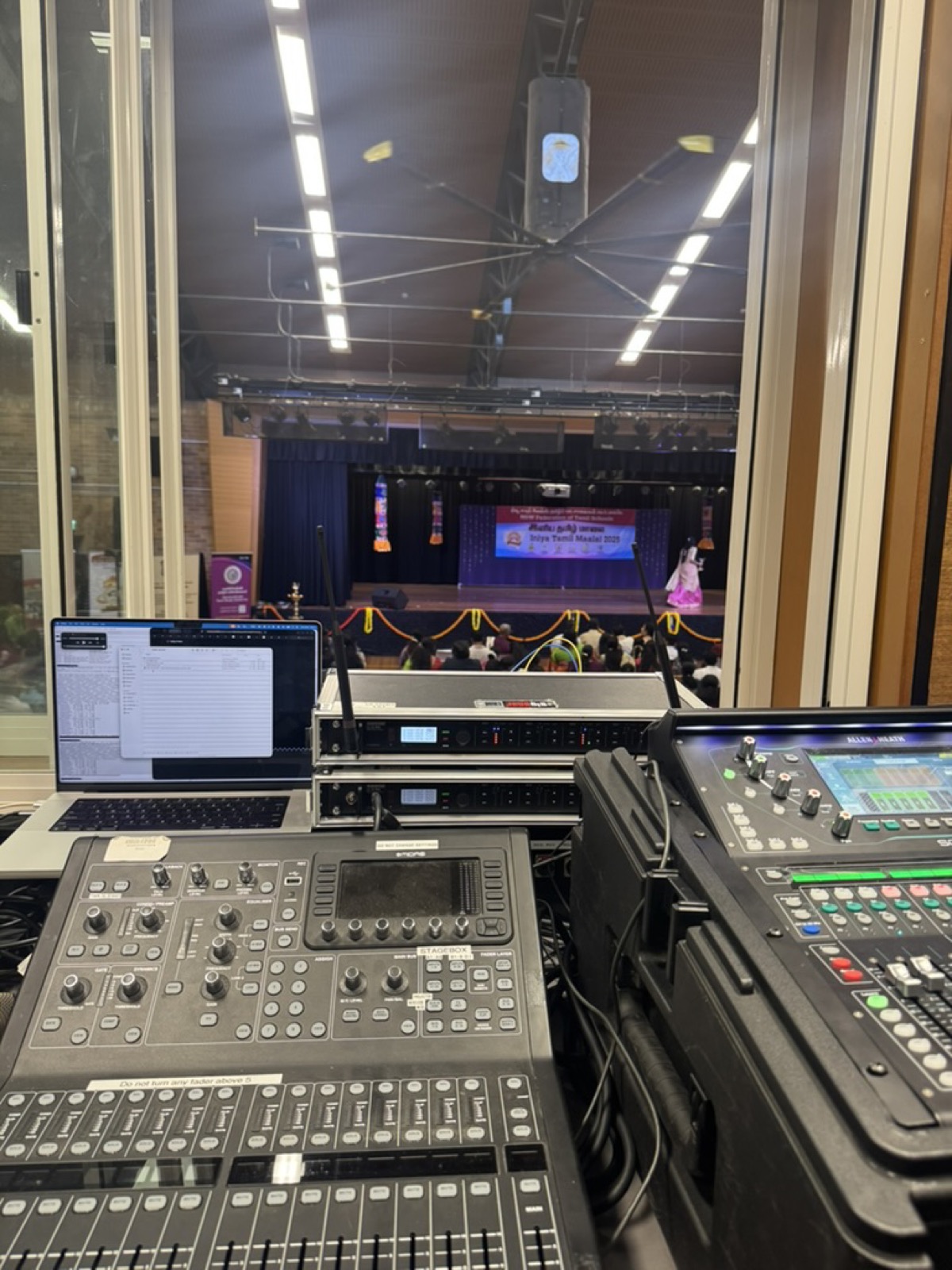
Event production is a service business. The vendor is selling crew, design, and orchestration. The gear is in scope, but the gear isn’t the product.
The production team designs the event around your run sheet. Audio scope built for the format (panels, keynotes, music, Q&A). Lighting designed for the room and the brand moment. Vision pipeline structured around how the audience will actually see the speakers and the slides. Recording and streaming planned to spec, with redundant paths and a contingency layer. Show calling, vendor coordination, run-of-show timecode, post-event delivery.
The crew is the differentiator. A senior audio engineer who has run hundreds of panels makes different choices than a junior tech on a delivery roster. Those choices show up in the recording, in the audience experience, and in whether anything noticeably fails on the day.
This is the right model when:
- The event has a brand moment that has to land. Keynote reveal, product launch, awards announcement.
- The format is panel-heavy or multi-room. The microphone scope, RF coordination, and audio mix exceed what a delivery-and-leave operator can do.
- A livestream or hybrid component is in scope. Broadcast-grade streaming is a production discipline, not a piece of gear that gets dropped off.
- The recording is the deliverable. CPD compliance, marketing cutdowns, archive. Post-production matters as much as the show.
- The venue is non-standard. Heritage spaces, marquees, outdoor configurations, multi-room conferences with synchronised content.
- Show-day risk is meaningful. Senior crew is the redundancy layer that hire models do not include.
A typical production scope absorbs equipment hire as a sub-cost. The gear is on the truck, but it’s there because the production design called for it, not because you line-itemed it.
The cost difference, honestly
Equipment hire is cheaper for the same gear list. A vendor renting you a PA, projector, and two microphones for the day will quote less than a production company doing the same job, because the production company’s quote includes crew design, run sheet coordination, and the senior tech who would otherwise be a $1,000-$1,500/day separate line.
For a 100-person meeting with slides, a panel, and a wireless mic: equipment hire might run $1,500 to $3,500 ex GST for the day. Production-led scope on the same brief sits in $4,000 to $8,000, because of the crew, not the gear.
The cost gap closes (and inverts) as event complexity grows. Once you add a livestream, multiple rooms, recording, lighting design, hybrid presenter integration, or any custom scenic, the production model is usually the more cost-efficient route because hire vendors will need to subcontract or partner for those layers, with markup.
By the time you’re scoping a 500-person conference with IMAG, broadcast streaming, and a recording package, the hire-only model has stopped being viable. You’re paying production prices either way; the question is whether one team coordinates it or whether you’re managing three vendors who don’t talk to each other.
How to know which one your event needs
The diagnostic that usually answers it: who is running the show on the day?
If the answer is “we are, our event manager has done this before, we just need the gear” then equipment hire is the right model. You’re saving money by not paying for production overhead you have internally.
If the answer is “the AV company is” then production is the right model. You’re buying that overhead because the event needs it.
A second diagnostic, less obvious but more honest: what happens if the headline session has a 90-second technical problem?
In an equipment hire scenario, the on-site tech (if present) will troubleshoot the gear. They will not redirect the run-of-show, coordinate with the venue, brief the host on how to fill the gap, or manage the audience experience while the issue gets resolved. That’s not their job.
In a production scenario, the production manager owns the 90-second problem. The show caller redirects the cue order. The host gets a discreet signal and adjusts. The vision director cuts to a graphic or a holding shot. The recording continues so post-event isn’t compromised. The audience often doesn’t notice anything happened.
If that distinction matters for your event, you need production.
A third option that’s increasingly common
Some events run a hybrid: equipment hire for the bulk of the gear, production team layered on top for the orchestration. The hire vendor delivers and operates the racks, projectors, and PA. The production team brings the show caller, vision director, run sheet, broadcast crew, and any custom design elements.
This works when the budget can’t quite stretch to full production-led scope but the event format still needs orchestration. It also works at venues that have their own in-house AV (like ICC Sydney) where the venue handles equipment hire as part of the booking, and an external production team layers in around the venue’s offering.
The risk in the hybrid model is interface management: who is responsible for what when something goes wrong on the day. Worth getting clear at brief, before signing either contract.
What to ask each vendor before you sign
For an equipment hire quote:
- What’s included in the day rate vs charged extra?
- Is a technician on site, or is the gear left for self-operate?
- If a piece fails on the day, what’s the replacement protocol and timing?
- Is delivery and pack-down within business hours, or surcharged for evening/overnight?
For a production quote:
- Who is the named senior tech on the show? What conferences have they run?
- What’s the contingency plan for the PA failing during the keynote?
- How does the brief change if we add a livestream or recording?
- What’s the post-event delivery: files, format, timeline?
If you’re not sure which model fits your event, the brief itself usually tells you. Standard format, internal-facing, hotel ballroom, in-house event manager: probably hire. Branded moment, hybrid streaming, recording matters, multi-room, custom design: production.
We do production. If your event reads like that, send us the brief and we’ll come back with a scope sized to what the day actually needs. If it reads more like equipment hire, we’ll tell you and recommend a Sydney hire company we trust. That conversation costs nothing and saves you both money.
More on Planning
- Planning
Fundraising gala AV: production that lifts the cause, not the invoice
A charity gala has a job no other event has: it has to feel generous while spending as little as possible on itself, because every dollar on AV is a dollar not raised. Here is how the production is scoped to move the room to give, without looking like the money went on the lights.
- Planning
Keynote production: building the room around a single person and a message
A keynote is the most exposed fifteen minutes in corporate AV. One person, one message, and a room watching to see whether the company has its act together. Timecode, confidence monitors, the presenter walk, and the rehearsal discipline that makes it look effortless.
- Planning
Press and media launch AV: producing for the cameras in the room as well as your own
A media launch has a second audience the brand does not control: the journalists and crews who will publish their own version of your event. A clean feed, a b-roll package, working interview positions, and embargo discipline. Here is how the AV scope serves the coverage, not just the room.