Conference AV by scale: what changes between 200, 500 and 1,000 delegates
Audience size is the first question every venue sales rep asks. It is also the wrong place to start an AV brief. What actually changes at each scale in a Sydney conference, the real price ranges, and the mistakes we see most often.
By Studio AV team
Audience size is the first question every venue sales rep asks. It is also the wrong place to start an AV brief.
A 500-person product launch and a 500-person internal town hall need almost nothing in common. What actually shapes AV scope is the room (depth, sight lines, rigging), the format (theatre, cabaret, classroom, Q&A), and how the audience participates. Headcount alone tells you very little.
That said, real inflection points exist where conference AV stops being one thing and becomes another. They land at 200, 500, and 1,000 delegates. Below is what changes at each, with the typical cost ranges we see in Sydney in 2026.
200 delegates: still a one-room production
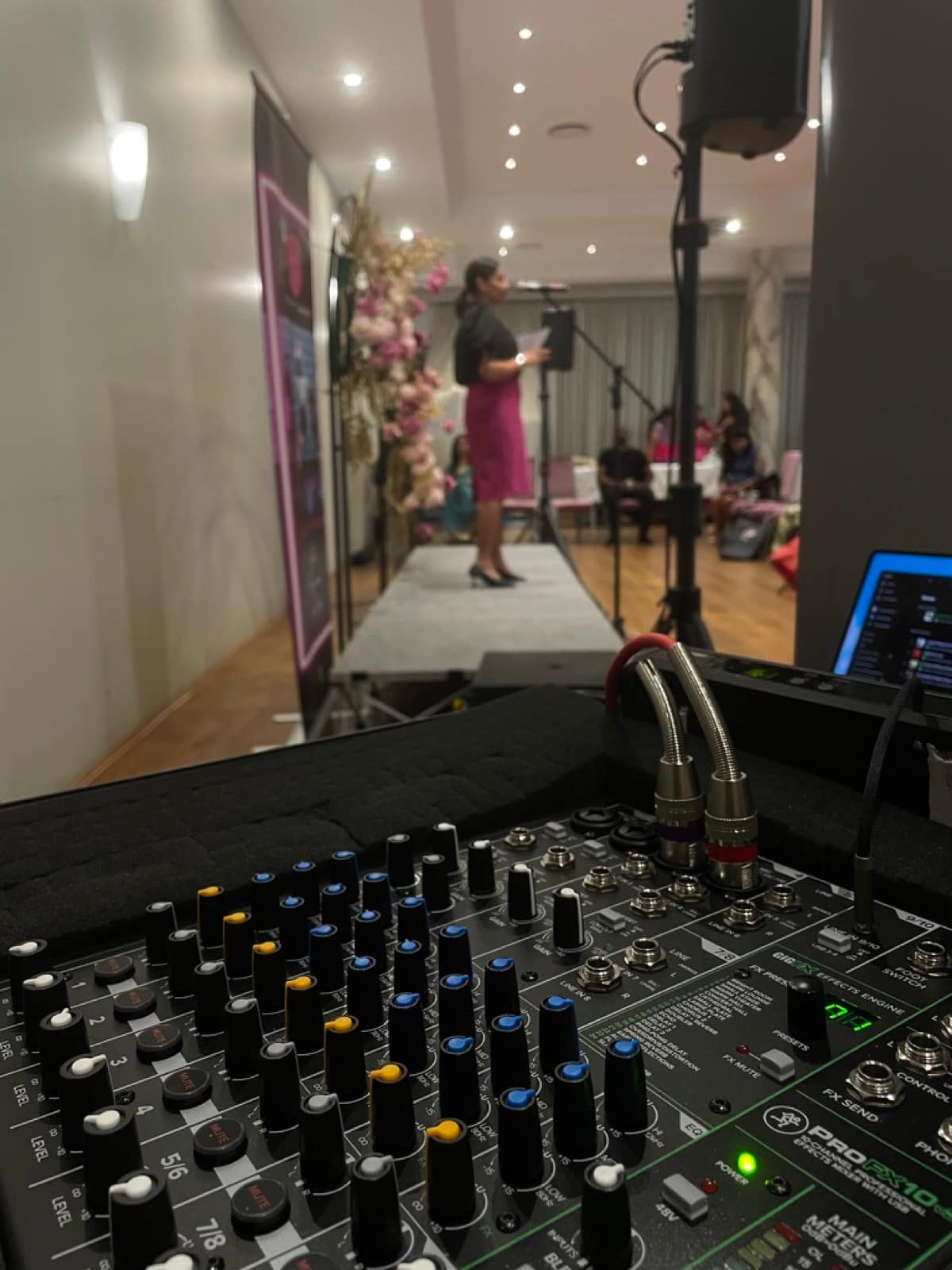
The 200-person conference is our most common shape, and the most often under-planned. Producers treat it as a slightly bigger boardroom event. It is not.
At 200 people in a single room, three things stop being optional. The PA needs to be a designed system (a point-source pair with a sub, tuned for the room), not whatever the venue has bolted to a wall. Vision moves to a dedicated screen plus a confidence monitor for the presenter. Audio inputs are no longer just the lectern: handheld for Q&A, lavalier if there is a panel, wireless backup of the lectern as standard.
Crew is two senior techs (FOH plus vision and comms) and a runner. A typical 200-person half-day in Sydney lands somewhere between $6,500 and $14,000 ex GST, driven by the venue more than the audience. A ballroom at the InterContinental sits near the bottom of that range. A heritage warehouse with no in-house gear and a four-hour bump-in sits near the top.
Where 200-person events fail: the audience Q&A microphones. Every one we have recovered mid-show was failing because the audience mics arrived late, were positioned wrong, or were not mixed with the same care as the lectern. If your event has Q&A, the audience audio is not the cheap part. It decides whether the second half of the event feels like a conference or a recording of one you cannot hear.
500 delegates: the production crosses a line

Somewhere between 350 and 500 delegates, the production stops being scalable and becomes structurally different. The change is not gradual.
Screens are the first visible shift. At 200 people, one screen at the front works. Row 12 can still read 24-point text from a slide. At 500, the back row cannot. You need either a much larger screen, or IMAG (image magnification) where additional screens around the room show a live cut of the presenter and slides. IMAG is not a single piece of gear. It needs cameras, a vision switcher, an operator cutting in real time, and a director calling the show. It adds a small department.
The PA also changes. A point-source pair stops dispersing evenly across a 500-seat room. You move to a small line array or a distributed system with delay speakers further back so the sound arrives at the same time as it arrives at the front. This is design work. It cannot be solved on the day.
Crew goes from two seniors to four or five: FOH audio, monitor audio for the IMAG cuts feed, vision switcher operator, vision director, show caller. Add a stream tech if there is a livestream. The broadcast feed cannot share attention with the in-room mix.
Sydney venues at this scale: the main hall at Carriageworks, the Darling Island or Hyde Park rooms at Doltone House, the larger ballrooms at the Hyatt Regency or InterContinental. A 500-person full-day with IMAG and a basic two-camera stream typically runs $22,000 to $48,000 ex GST. The same audience without IMAG and without streaming is cheaper, but also much less polished for anyone past row 10.
The mistake we see at 500: skipping IMAG to save money. The room ends up with the back third watching slides they cannot read and a presenter they cannot really see. The post-event survey shows it every time. The cost of the missing piece is not the money you saved on cameras. It is the perception of the whole event.
1,000+ delegates: a different discipline

A 1,000-person plenary is not a bigger version of a 500-person conference. It is a different production discipline, run by people whose week-to-week work is closer to broadcast than to conference AV. If your vendor’s pitch does not acknowledge this, that is a signal.
The PA is a line array per side, usually with subs flown or arrayed at the front. Screens are either large-format LED walls or a combination of main IMAG and distributed delay screens. Cameras go to four or more: a wide locked-off, two operated mediums for presenter framing, and a roving handheld for Q&A coverage.
Crew becomes a department per discipline. Audio runs FOH and monitors as two seats. Vision has the director, a switcher operator, and camera ops. Lighting is its own desk for anything with a designed look. Production management is a full-time role across bump-in, show, and bump-out. A floor manager runs the speaker holding area and cues people on stage. The stream, if there is one, has its own producer and director independent of the in-room production. Plan for 8 to 14 people on a crew sheet for a single show day.
Sydney venues at this scale narrow quickly: the plenary at ICC Sydney, the Concert Hall at the Sydney Opera House for events that suit it, the larger Doltone House Darling Island configuration, the Hordern Pavilion for less formal formats. Conversations with these venues start with rigging plots and three-phase power, not with whether the room has a projector.
A 1,000-person single-day with a broadcast-grade stream and full lighting design typically lands between $65,000 and $180,000 ex GST. The spread is real and is driven mostly by lighting scope, LED screen size, and streaming tier. A no-lighting-design plenary with a basic stream sits near the bottom. A product launch shell with branded staging, designed lighting and a hero stream sits near the top.
What most people get wrong at this scale: assuming the crew scales 5x because the audience does. It does not. Crew scales sub-linearly because the structure changes, not just the headcount. 200 was a tight crew of two; 1,000 is a coordinated set of departments, each with one or two people in it, plus the leads who tie them together.
The variables that move the price more than headcount
Three things determine AV cost more than audience size.
The first is the streaming tier you actually need. A single-camera stream for an internal town hall is one number. A broadcast-grade hybrid where the remote audience is treated as a first-class audience is another, often double or more. Decide which one you want before you write the brief. Paying broadcast prices and getting basic execution, or the inverse, is the worst outcome.
The second is venue complexity. A purpose-built conference venue with house PA, in-ceiling projection, working rigging points, and a friendly ops team is cheap to produce. A heritage venue with no in-house gear, restricted rigging, a four-hour bump-in window, and noise restrictions is expensive before you add anything fancy. The cost spread between two venues on the same conference can easily be 2x.
The third is crew seniority. A senior crew of three will outperform a junior crew of six for most conferences under 500 people. The price gap between senior and junior technicians sits around 30 to 50%. The gap in show-day outcomes is much bigger. Junior crews need more direction and more hands. Senior crews are faster, make fewer mistakes during the show, and are calmer in the moments that count. If one vendor’s crew is materially larger than another’s for similar money, ask about seniority.
What to ask your vendor before you sign
Three questions surface whether the vendor has actually thought about your event.
What is your contingency plan for the PA failing during the keynote? A vendor who hesitates here is improvising. The right answer is specific and rehearsed: a backup PA path with manual failover, a spare wireless mic ready to swap inside 30 seconds, a redundant playback path for any pre-recorded media.
Who is the senior tech on the show, and what conferences have they run? The names matter more than the company logo on the proposal. If the vendor does not know yet which engineer they are putting on your event, you are being sold a crew before the crew is decided.
How does the brief change if we add a livestream? A vendor whose answer is “we add a camera and an encoder” has not internalised the difference between adding a stream and producing a broadcast. The right answer talks about audio routing for the stream mix, comms for the stream director, redundant encoder paths, and how the in-room show changes (IMAG sources, run sheet timing, presenter framing) to make the stream watchable.
Conference AV scales with thoughtfulness, not headcount. The right vendor will tell you what your scope actually needs and where you can cut without hurting the event. The wrong vendor will quote whatever you brief and let you find out on the day.
Planning a Sydney conference at any of these scales? We run them every week. Send us a brief and we will come back with a fixed-quote proposal in two business days.
More on Planning
- Planning
Fundraising gala AV: production that lifts the cause, not the invoice
A charity gala has a job no other event has: it has to feel generous while spending as little as possible on itself, because every dollar on AV is a dollar not raised. Here is how the production is scoped to move the room to give, without looking like the money went on the lights.
- Planning
Keynote production: building the room around a single person and a message
A keynote is the most exposed fifteen minutes in corporate AV. One person, one message, and a room watching to see whether the company has its act together. Timecode, confidence monitors, the presenter walk, and the rehearsal discipline that makes it look effortless.
- Planning
Press and media launch AV: producing for the cameras in the room as well as your own
A media launch has a second audience the brand does not control: the journalists and crews who will publish their own version of your event. A clean feed, a b-roll package, working interview positions, and embargo discipline. Here is how the AV scope serves the coverage, not just the room.